
"Sometimes the most productive thing you can do is relax." — Mark Black
"Sometimes the most productive thing you can do is relax." — Mark Black

Take Care
Come Back to Yourself
Self-care can be a quick reset or a deeper ritual. One breath. One song. One walk. One finger hold. One quiet hour where you stop treating yourself like an afterthought.
This space offers simple practices and gentle reminders to help you slow down, soften, and come back to yourself.
Because your well-being matters.
Come Back to Yourself
Self-care can be a quick reset or a deeper ritual.
One breath. One song. One walk. One finger hold. One quiet hour where you stop treating yourself like an afterthought.
This space offers simple practices and gentle reminders to help you slow down, soften, and come back to yourself.
Because your well-being matters.
These practices are simple tools for relaxation and self-awareness. They are not medical treatment, and they are not meant to replace care from a doctor, therapist, or other health professional. If something feels uncomfortable, stop. If you have a health condition, trauma history, dizziness, breathing issues, heart concerns, or anything that makes body-based practices tricky, keep it gentle and check with a professional.
Vagus Nerve Reset
Tell Your Body It Can Stand Down
The vagus nerve plays a major role in the body’s “rest and digest” system. Simple practices like intentional breathing, gentle movement, and relaxation techniques can help support the body’s shift out of high-alert mode and into a calmer state. Cleveland Clinic describes purposeful breathing as one of the simplest ways to support vagus nerve regulation because it can help slow breathing, reduce heart rate, and support relaxation.
This is not about forcing calm.
It is about offering your body a little evidence that the emergency may not be as emergency-ish as it feels.
Key Vagus Nerve Relaxation Techniques
Deep Diaphragmatic Breathing (Belly Breathing): Focus on long, slow exhales. A recommended technique is breathing in for 4 seconds, holding for 7, and exhaling for 8 seconds to maximize stimulation.
Humming or Singing: Because the vagus nerve passes through the vocal cords, humming or singing creates vibrations that activate it, reducing stress and boosting heart rate variability.
Cold Water Immersion: Splashing cold water on the face or holding an ice pack on the chest can trigger the diving reflex, which directly stimulates the vagus nerve.
The "Basic Exercise": Developed by Stanley Rosenberg, this involves lying down, locking fingers behind the head, and looking to the right until a yawn or sigh occurs, then repeating on the left side.
Eye Movement/Vagus Reset: Look to the right while keeping the head facing forward until a natural swallow, sigh, or yawn happens. Repeat on the left side.
Massaging the Neck and Face: Gently massaging the side of the neck (near the carotid sinus) can stimulate the nerve
Finger holding for emotional reset
Hold a Finger. Help Your Nervous System Get the Memo.
It may sound woo woo but it really works!
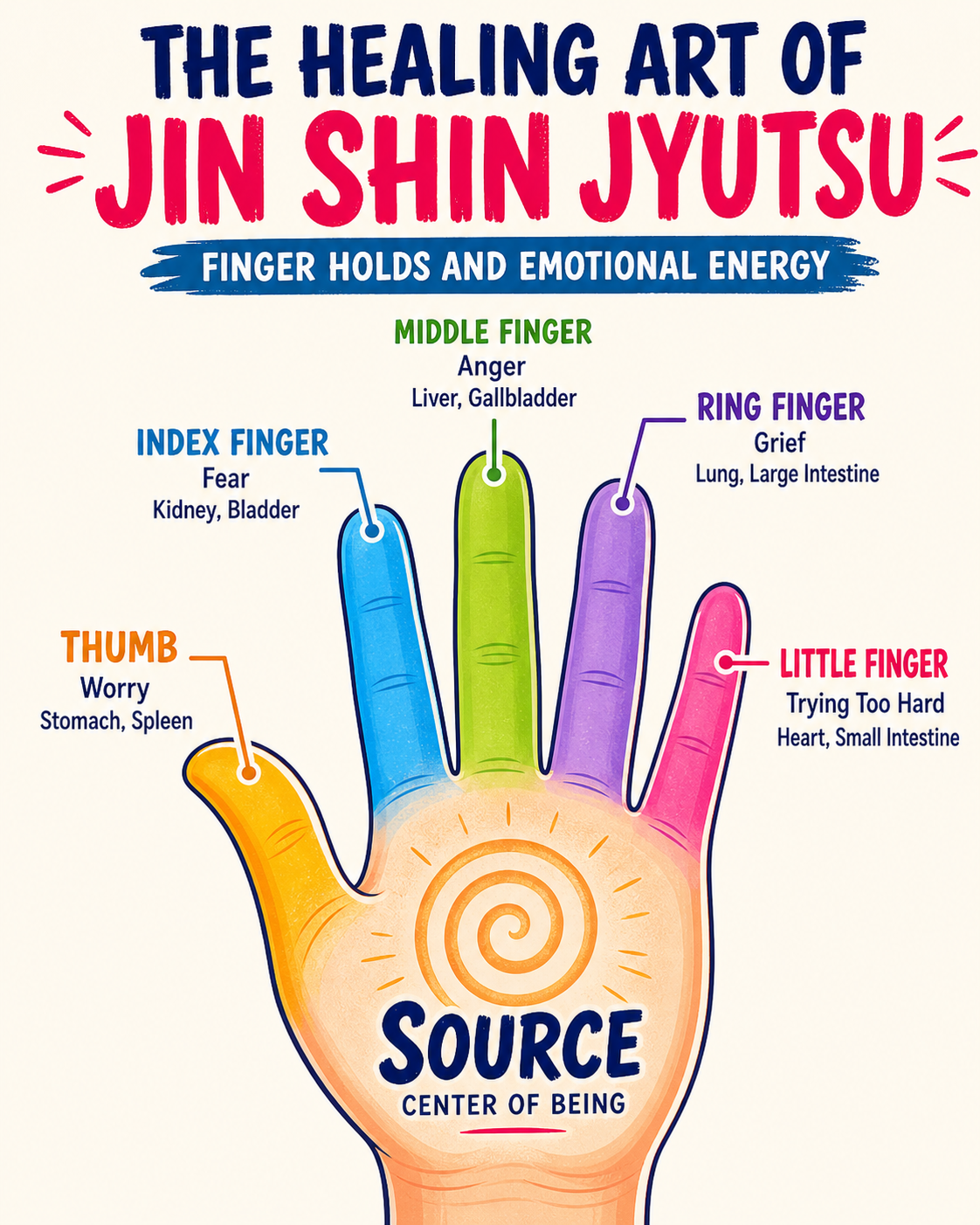
Jin Shin Jyutsu, often called JSJ, is a Japanese self-help practice that uses gentle touch to support emotional balance and body awareness. One simple JSJ technique is to lightly hold each finger for a few minutes while breathing slowly. In JSJ, each finger is associated with an “attitude,” or emotional pattern, such as worry, fear, anger, grief, or trying too hard.
No squeezing. No forcing. No dramatic hand choreography.
Just hold gently and breathe.
How to:
Wrap one hand gently around a finger on the other hand.
Hold for 2 to 5 minutes, or simply for a few slow breaths.
Relax your shoulders.
Breathe slowly.
Switch fingers, switch hands, or stop whenever you are done.
You can do this while sitting, lying in bed, watching TV, waiting in line, or pretending you are listening politely in a meeting.
No one has to know you are emotionally rebooting.
| Finger | Emotional Focus | Gentle Reminder |
|---|---|---|
| Thumb | Worry, anxiety, overthinking | “I can soften this.” |
| Index Finger | Fear, nervousness, mental tension | “I can find steadiness.” |
| Middle Finger | Anger, frustration, irritation | “I can pause before I react.” |
| Ring Finger | Sadness, grief, trying too hard | “I can let myself feel.” |
| Little Finger | Effort, insecurity, pretending | “I do not have to perform being okay.” |
Mindfullness
Ten Minutes Counts. So Does One.
Mindfulness does not have to mean incense, silence, or sitting cross-legged while pretending your foot is not asleep.
At its simplest, mindfulness is noticing what is happening right now without immediately trying to fix, judge, decorate, or flee from it.
Andy Puddicombe’s TED Talk, “All it takes is 10 mindful minutes,” frames mindfulness as taking 10 minutes a day to refresh the mind by being present. TED’s description specifically notes that it does not require incense or uncomfortable sitting positions, which makes it a very good fit for your tone.
Tiny Mindfulness Practices
| Practice | Try This |
|---|---|
| One Breath Check-In | Take one slow breath and notice where your body is holding tension. |
| Five Things You See | Name five things around you. No need to make them profound. “Lamp” counts. |
| One Sip Pause | Take one sip of water, coffee, or tea without doing anything else. Revolutionary, apparently. |
| Feet on the Floor | Feel both feet on the ground and let your shoulders drop a little. |
| Name the Weather | Ask, “What is the weather inside me right now?” Cloudy? Windy? Weirdly glittery? All valid. |